Google Reviews for Med Spas: Why They Decide Who Books

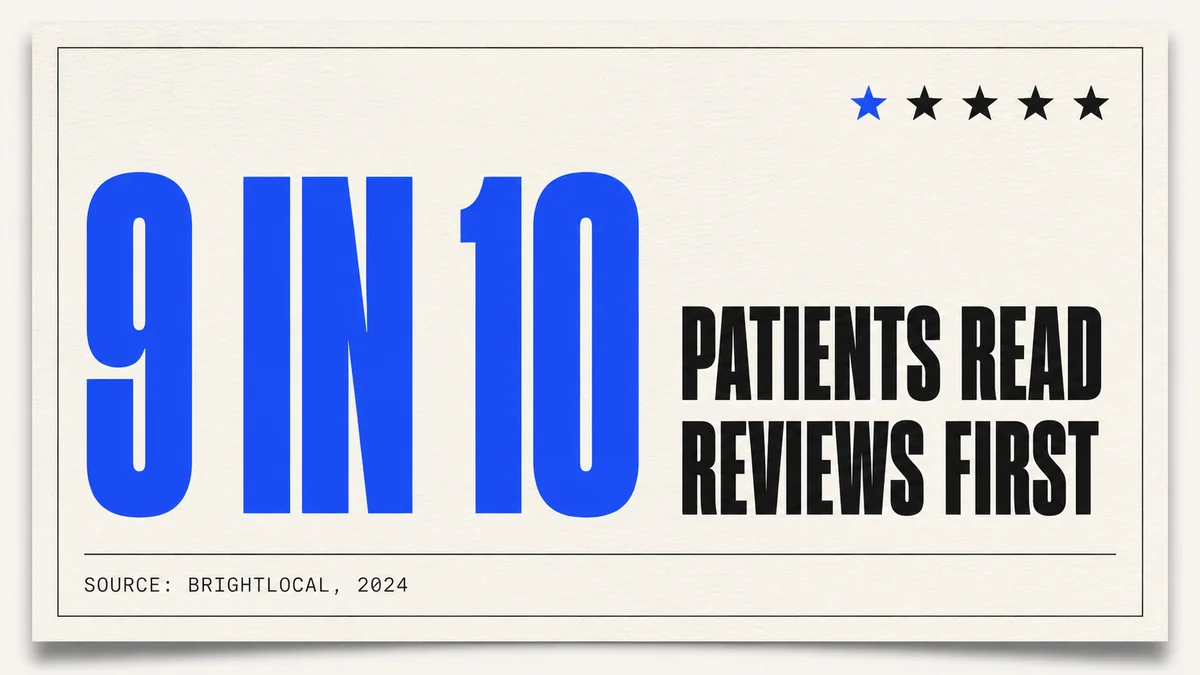
Google reviews for med spas are the moment the booking decision gets made. Before a new patient books, she reads your reviews, and in BrightLocal's Local Consumer Review Survey more than 9 in 10 consumers do exactly that before choosing any local business. Your review count, your average rating, and how recently you were reviewed decide whether she books you or the med spa two miles away. Lunere Digital builds the booking system that turns that review-driven attention into filled appointments, and this post shows you how the reviews part actually works.
- Why do Google reviews decide which med spa gets booked?
- How many Google reviews does a med spa actually need?
- Do Google reviews actually affect map pack ranking?
- How do you get more Google reviews without breaking the rules?
- What should you do about negative and fake reviews?
- Turning reviews into booked patients
- Google reviews are a booking gate, not a vanity metric. Most patients read them before they ever visit, and a thin profile loses the appointment before you know the patient existed.
- Volume, average rating, and recency all matter, but review velocity (new reviews every month) does more for your map pack ranking than a big stale total.
- You cannot buy, incentivize, or gate reviews without breaking Google's rules, and med spa responses carry a HIPAA wrinkle most owners get wrong.
- Responding to every review, good and bad, measurably increases how many patients will use you. Silence costs you bookings.
- Reviews are the cheapest leak in a med spa's booking system to fix, and the first place Lunere looks.
Your injectors could be the best in the city. Your pricing could be fair. None of that reaches a new patient if your Google reviews lose the comparison before she ever calls. Google reviews for med spas are not a marketing nicety. They are the moment the booking decision gets made, usually on a phone, in about eight seconds, while she is looking at you next to three competitors. Lunere Digital builds patient-booking systems for med spas, which means turning your website and Google presence into something that books new patients on autopilot. Reviews are the part of that system almost every owner underinvests in, and the part that quietly caps how full your calendar can get.
This is not a reputation-management sales pitch. It is how the machinery works, what the numbers actually say, and what to do this month.
Why do Google reviews decide which med spa gets booked?
Because reviews are the first thing a prospective patient checks, and aesthetic treatments carry enough real risk that she checks hard. In BrightLocal's Local Consumer Review Survey, more than 9 in 10 consumers read online reviews before choosing a local business. For injectables, lasers, and body work, that scrutiny goes up, not down. She is choosing who puts a needle in her face.
Picture the actual moment. She searches "botox near me" or taps your Instagram link. Google shows your profile next to two others. Yours reads 23 reviews at 4.1 stars. The clinic down the street reads 180 reviews at 4.8. She books the clinic down the street. Your injector may be more skilled and your price may be lower, but she never finds out, because the review comparison ended the decision before a human at your front desk was ever involved.
That is why a weak review profile is so expensive. It does not just lose the patients who complain. It loses the patients you never hear from, the ones who compared, decided, and booked elsewhere in silence. Every dollar you spend on ads or SEO to get seen pours into a profile that then fails the comparison. Fixing the reviews raises the return on everything else you are already paying for.
How many Google reviews does a med spa actually need?
There is no magic number, and chasing one is the wrong game. What matters is that you look credible next to the specific competitors in your city and that new reviews keep arriving. In most mid-size markets, the med spas winning the map pack carry review counts well into the triple digits with averages above 4.5 stars, but the count that beats your market is the only count that matters.
Here is the part owners miss: a steady drip of new reviews beats a big frozen total. A med spa adding eight to fifteen fresh reviews a month will often outrank a competitor sitting on 200 reviews that all stopped two years ago. Recency signals to both Google and the patient that the place is busy, current, and safe right now.
So do not fixate on a target like "get to 100." Set a rate instead. A simple monthly rhythm of new reviews compounds into ranking, trust, and bookings at the same time.
Track two numbers, not one: your total review count and your reviews-in-the-last-30-days. The second number is the one that predicts your ranking trend. Most owners have never written either one down.
Do Google reviews actually affect map pack ranking?
Yes, and it is one of the heaviest levers you control. In Whitespark's 2026 Local Search Ranking Factors report, the two biggest categories for local map pack ranking are Google Business Profile signals at roughly 32 percent and review signals at roughly 20 percent. Together those two, both largely in your control, outweigh everything else.
Review signals are not just star rating. Google weighs quantity, velocity, recency, the words inside your reviews, and whether you respond. Whitespark's 2026 data ranks review recency among the top local factors, which is the ranking-side reason the monthly-rhythm approach beats a one-time push.
| Review signal | What it means | What to do |
|---|---|---|
| Volume | Total number of reviews | Beat your local competitors' count, not an arbitrary target |
| Velocity and recency | New reviews arriving steadily | Aim for a consistent monthly rate, never a one-time blitz |
| Average rating | Your star average | Protect it by fixing service issues, not by hiding reviews |
| Keywords in reviews | Treatments patients name | Prompt happy patients to mention the specific service |
| Response rate | Replies to reviews | Respond to every review, positive and negative |
The takeaway is simple. Your Google Business Profile and your reviews are the two dials that move your ranking most, and unlike ad spend, they keep working after you stop touching them. This is the same local-visibility problem covered in why the GoDaddy website builder is costing you local SEO, viewed from the review side.
How do you get more Google reviews without breaking the rules?
You ask every happy patient, at the right moment, through a system that makes leaving a review take fifteen seconds. What you do not do is buy them, bribe them, or block the unhappy ones. That last part is where med spas get themselves in trouble.
- Ask at peak happiness. The best moment is right after a result the patient loves, at checkout or in a follow-up text a day later. Ask when the feeling is fresh, not a month later.
- Make it one tap. Send a direct link to your Google review form by text. Every extra step you add cuts the number of reviews you get. Friction is the enemy.
- Automate the ask. A booking system can text the review request automatically after each visit, so it happens every time instead of when someone remembers. This is the part Lunere builds in.
- Prompt the treatment name. A simple "if you have a second, mention which treatment you had" nudges reviews that name botox, filler, or laser, which helps you rank for those exact searches.
- Respond to build the habit. Replying to reviews tells the next patient you are attentive, and it encourages more people to leave them.
Never gate reviews (sending happy patients to Google while routing unhappy ones to a private form) and never offer a discount, free product, or entry into a drawing in exchange for a review. Both violate Google's prohibited and restricted content policy and can get your reviews filtered or your profile penalized. The goal is more real reviews, not manufactured ones.
There is also a compliance wrinkle unique to medical aesthetics that most generic advice ignores. When you respond to a review, you cannot confirm that the person was your patient, name their treatment, or share any detail about their visit, because doing so discloses protected health information. A cheerful "So glad we could help with your lip filler, Jessica!" is a HIPAA problem, even though the patient posted publicly. The safe move is a warm, generic reply that thanks them and invites them to reach out privately, never confirming care.
What should you do about negative and fake reviews?
Respond to every negative review calmly and publicly, because the reply is written for the next reader, not the angry one. Patients expect it, and the response itself changes behavior. In BrightLocal's Local Consumer Review Survey, 88 percent of consumers said they would use a business that responds to all of its reviews, compared with only 47 percent for a business that responds to none. Silence is not neutral. It costs you the booking.
A negative review with a calm, human reply underneath it often converts better than no negative reviews at all. It proves you are real.
Keep three rules in mind when you reply to a bad review at a med spa:
- Stay HIPAA-safe. Do not confirm the person was a patient or reference their treatment. Thank them, express that you take concerns seriously, and move the conversation to a private channel.
- Stay calm and short. Two or three sentences. You are showing the next patient how you handle friction, not winning an argument.
- Fix the underlying issue. If three reviews mention the same wait time, the reviews are telling you something your calendar is doing wrong.
For genuinely fake or defamatory reviews, flag them to Google for removal, but do not count on it. The stronger defense is a steady stream of real positive reviews that pushes one bad one down the page. And remember that 97 percent of people who read reviews also read the owner's responses, so your replies are public-facing marketing whether you treat them that way or not.
Turning reviews into booked patients
Reviews get the patient to your door. The booking system decides whether she walks through it. A five-star profile that sends people to a slow website with a clunky contact form leaks the patient you just earned. That is why reviews are one input into a booking engine, not a standalone project.
The sequence that fills a calendar looks like this: your Google presence and reviews win the click, your website answers her questions and lets her book in seconds, and your follow-up responds before she cools off. If any link is weak, the whole chain loses patients. Reviews are usually the cheapest link to strengthen first, which is why they are the first place we look. See what the rest of the chain requires in what a med spa website must do in 2026, and how speed closes it in the 5-minute rule that decides which med spa books. Once patients are booked, keeping them is a separate system, covered in how to reduce med spa no-shows without hiring anyone.
My honest view after building these systems: the review gap is the cheapest leak in a med spa's booking system and the one owners put off the longest. It costs nothing but a fifteen-second ask after each visit, and it lifts the return on every ad and every SEO dollar you already spend. Most owners spend months chasing new traffic while a thin, silent review profile quietly turns that traffic away.
FAQ
How many Google reviews does my med spa need to compete?+
There is no fixed number. What matters is looking credible next to the specific competitors in your city, usually a review count in the triple digits with an average above 4.5 stars in a competitive market, and a steady flow of new reviews. Review velocity, meaning fresh reviews every month, does more for your ranking than a large but stale total.
Can I offer a discount for a Google review?+
No. Offering any incentive, including discounts, free products, or a prize drawing, in exchange for reviews violates Google's prohibited content policy and can get your reviews filtered or your profile penalized. Ask happy patients to review you at the right moment instead, with no strings attached.
How do I respond to a med spa review without breaking HIPAA?+
Keep replies warm and generic. Do not confirm the person was a patient, name their treatment, or share any detail about their visit, because that discloses protected health information. Thank them, note that you take feedback seriously, and invite them to contact you privately if there is an issue to resolve.
Do Google reviews really affect where my med spa ranks?+
Yes. In Whitespark's 2026 Local Search Ranking Factors report, review signals account for roughly 20 percent of local map pack ranking and Google Business Profile signals for roughly 32 percent, making them two of the heaviest levers you control. Reviews influence both whether you rank and whether the patient who sees you books.
Should I respond to negative reviews?+
Always. In BrightLocal's Local Consumer Review Survey, 88 percent of consumers would use a business that responds to all its reviews versus 47 percent for one that responds to none. A calm, HIPAA-safe public reply is written for the next reader, and it often converts better than having no negative reviews at all.
How well does your med spa turn attention into booked patients?
See your Patient Booking Scorecard: how your med spa scores 0 to 100 at turning online attention, including your reviews, into booked patients, where you are losing them, and what it costs each month. 2 minutes, no call.
Get my free scorecard